Journal · the land
Who else lives on the course
Herons, badgers, bats and a lot of gophers share the fairways.
The golf course at St. Eugene is also a habitat. A 2022 article on the resort's site explains how the course was laid out to leave room for the animals already living there.
The numbers
The course covers 327 acres, according to the article. Only 120 of them are maintained turf. The other 207 are left alone so as not to disturb the wildlife. The design includes buffer zones, wetlands, ponds and wildlife corridors, which the resort says were part of the plan before ground was broken.
Who has been seen
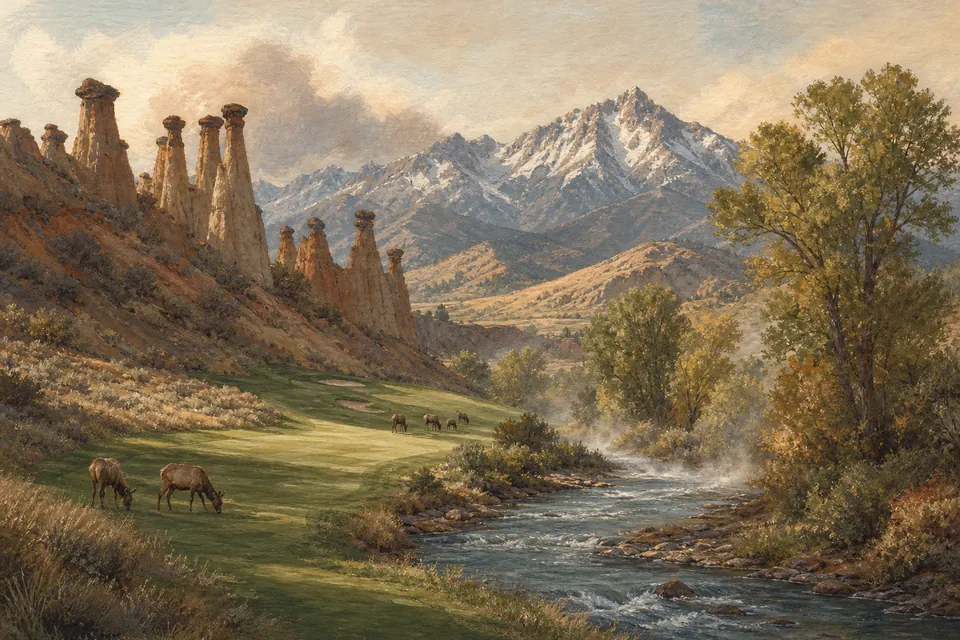
More than 100 species of birds had been recorded on the course over the previous 15 years, the article says, and the 2025 anniversary article repeats the figure. The course is a member of the National Audubon Society. Among the animals the article names are the great blue heron, the bald eagle, the badger, the Townsend's long-eared bat and the painted turtle. Golfers have reported elk, moose, black bears and grizzlies, and the article adds, "many, many gophers".
On the signs
Several hole names tell the same story. Hole 4, Circling Raven, remembers a fledgling raven that a turf worker put back on a branch while its flock circled overhead. The next day it was safely home. Hole 8, Spring Fawn, tells of a doe choosing a place to give birth between the river and the open fairway. Hole 12, Rising Spirit, describes a bald eagle forcing an osprey to drop its trout. Hole 18 is named after the belted kingfisher, which hunts along Joseph Creek and the St. Mary River.
What golfers are asked to do
Some hazards are closed to protect fragile ground. Balls that end up there are collected by the grounds crew and given away, so nobody needs to go in after them. Joseph Creek, which runs through the resort, is a spawning stream and is described on the first hole's sign as environmentally sensitive.
Where this comes from
Wildlife at St. Eugene (2022), course information, read 15 November 2026.